When the lights go out, a reliable backup power source isn't just a convenience—it's a lifeline. And if you're like many homeowners today, you're likely considering the smart versatility of a dual fuel generator. But with so many options, how do you go about choosing the best Westinghouse dual fuel generator for your home backup needs?
As a seasoned journalist covering home essential systems, I've seen firsthand the peace of mind a well-chosen generator can bring. Westinghouse, a name synonymous with power innovation, offers a robust lineup of dual fuel models designed to keep your home running smoothly, whether you're facing a short outage or an extended grid failure. This guide will cut through the technical jargon, offering practical advice and specific recommendations to help you make an informed decision you won't regret.
At a Glance: Your Westinghouse Dual Fuel Generator Checklist
- Assess Your Power Needs: Calculate essential circuits first, then consider comfort items.
- Embrace Fuel Flexibility: Understand the pros and cons of gasoline and propane for your situation.
- Prioritize Safety Features: CO sensors, low-oil shutoff, and overload protection are non-negotiable.
- Mind the Noise: Conventional generators are loud; inverters are quieter for sensitive environments.
- Consider Portability: Wheel kits are essential for heavy units; know your transport limits.
- Plan for Connection: Most high-capacity generators require professional transfer switch installation.
The Dual Fuel Advantage: Why Versatility Matters
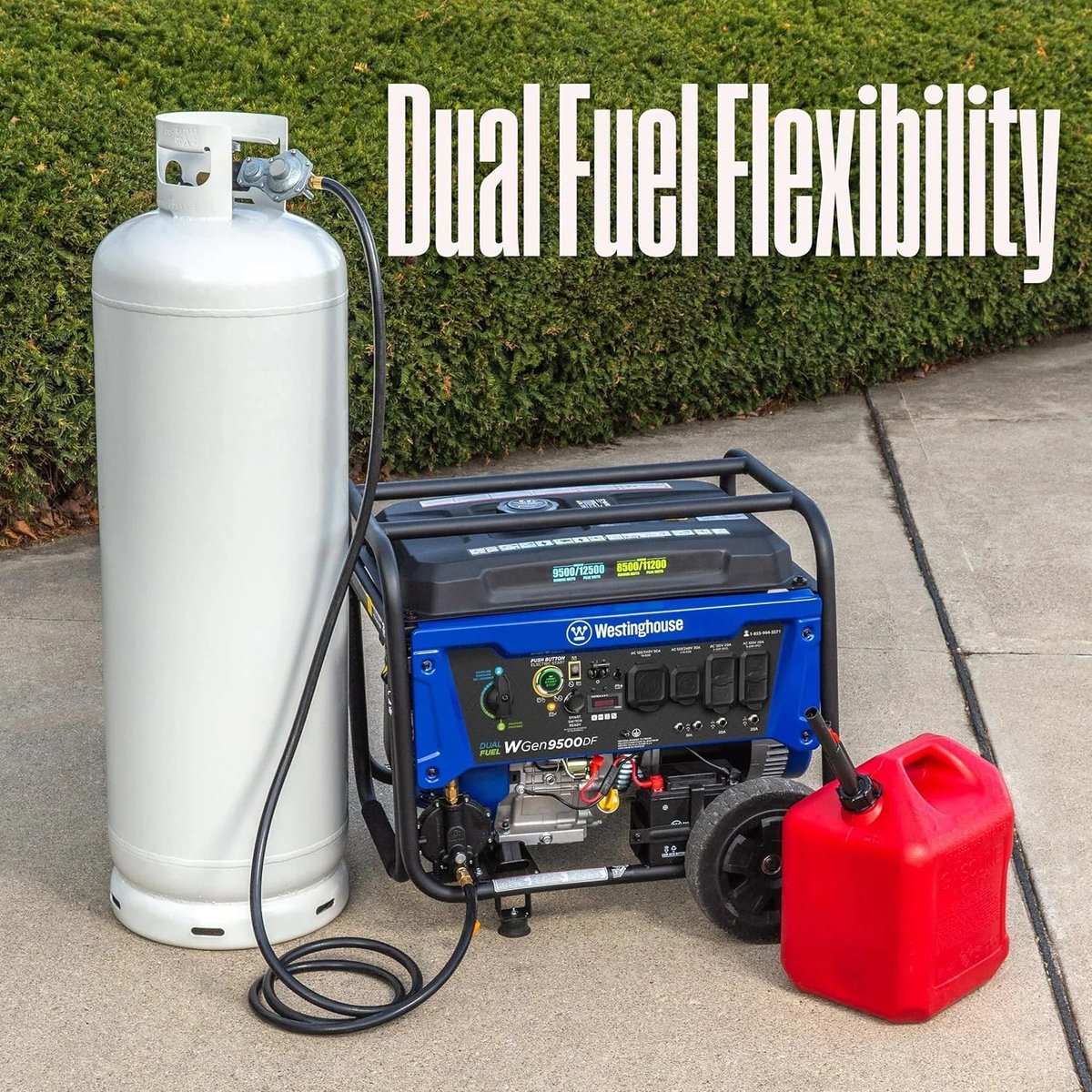
A dual fuel generator is exactly what it sounds like: a power generator capable of running on two different fuel sources, typically gasoline and liquid propane. This isn't just a fancy feature; it's a significant strategic advantage, especially for home backup.
Think about it: during a widespread power outage, gasoline can become scarce and lines at the pump grow impossibly long. With a dual fuel unit, you have the option to switch to propane, which can be stored safely for much longer periods and might be more readily available from multiple sources. This flexibility greatly extends your potential runtime and reduces your reliance on a single, potentially compromised fuel supply.
Propane also offers a cleaner burn, leading to less engine wear and tear over time, and it's less prone to spills. Gasoline, on the other hand, often provides a slightly higher wattage output and is universally available in normal times. Having both options means you're prepared for more scenarios.
Critical Safety Reminder: Regardless of the fuel type, all portable generators—dual fuel included—produce toxic carbon monoxide fumes. They must always be operated outdoors in a well-ventilated, sheltered area, far from windows and doors. Never run a generator in a garage, basement, or any enclosed space.
Decoding Power: Watts, Peak, and Running
When generator shopping, you'll encounter two main wattage figures: "peak power" (or "surge watts") and "running power" (or "continuous watts").
- Peak Power: This is the maximum output a generator can provide for a short burst, typically needed to start motors that have a high initial current draw (like refrigerators, well pumps, or air conditioners).
- Running Power: This is the steady, continuous wattage the generator can produce consistently over time to keep your appliances operating.
Always focus on the running power when matching a generator to your actual needs, but be sure the peak power is sufficient for any motor-driven appliances you plan to start simultaneously. Westinghouse generators clearly delineate these figures, making it easier to compare models.
How Much Power Do You Really Need?
This is the most crucial question. Don't just guess; take a moment to tally up your home's essential loads.
- Identify Critical Appliances: What absolutely must run during an outage? Think refrigerator, freezer, well pump, furnace fan, lights, charging phones, medical equipment.
- Find the Wattage: Look for wattage labels on your appliances (often on the back or bottom). For motors, note both running and starting (surge) watts.
- Calculate Your Total:
- Add up the running watts of all critical items you want to power simultaneously.
- Identify the single highest starting wattage appliance. Add this to your total running watts (but only once, for the largest motor).
Example Scenario: - Refrigerator: 800 running watts, 2000 starting watts
- Furnace Fan: 600 running watts, 1500 starting watts
- Lights (various): 500 running watts
- Phone Chargers: 100 running watts
Calculation: (800 + 600 + 500 + 100) running watts = 2000 running watts.
Highest starting watt appliance (refrigerator) = 2000 watts.
Total minimum generator running watts needed: 2000 watts.
Total minimum generator peak watts needed: 2000 (running total) + 2000 (highest starting surge) - 800 (running watt of that same appliance) = 3200 watts.
It's always better to slightly overestimate than underestimate. A generator that's too small will be constantly overloaded, potentially damaging both the generator and your appliances. When exploring various Westinghouse dual fuel generators, keep your wattage calculations handy.
Beyond the Watts: Key Features to Consider
Once you have a general idea of your power requirements, delve into the features that define a generator's usability, safety, and overall value.
Starting Mechanisms: Effortless vs. Dependable
- Electric Start: A simple push-button or switch, typically powered by an onboard battery. This is a game-changer for ease of use, especially if you need to start the generator quickly or in inclement weather. Most modern Westinghouse units feature this.
- Recoil Start: The classic pull-cord. It's reliable, doesn't depend on a battery, and serves as an excellent backup for an electric start. It's crucial for generators stored for long periods.
- Remote Key Fob Start: The ultimate convenience, allowing you to start the generator from inside your home (though you'll still need to go outside for refueling and safety checks). Some Westinghouse models offer this.
Noise Levels: Your Neighbors (and Ears) Will Thank You
Generators, by their nature, are loud. Their noise level is measured in decibels (dB).
- Typical Conventional Generator: 65-75 dB, comparable to a normal conversation or a vacuum cleaner. Louder models can reach 90 dB (like a hair dryer or motorcycle).
- Inverter Generators: These are significantly quieter, often as low as 52 dB, similar to a refrigerator. If you're in a close-knit neighborhood, camping, or just prefer peace and quiet, an inverter is a strong contender.
Keep in mind that gasoline operation is generally louder than propane. Always check the dBA rating before you buy, especially if noise is a concern.
Fuel Capacity & Runtime: How Long Will It Last?
- Gasoline: Generators come with integrated fuel tanks ranging from 2 to over 10 gallons. A larger tank means longer runtime between refills.
- Propane: Propane is stored in external tanks (e.g., 20-pound BBQ tanks), offering flexibility but requiring you to manage multiple canisters.
Runtime is typically measured at 25% or 50% load. Always consider your expected load to gauge realistic runtime. The beauty of dual fuel is that you can often use both sequentially to extend your total power duration.
Portability: Moving a Mini Power Plant
Generators are heavy beasts, often weighing 100-250+ pounds, with some exceeding 350 pounds.
- Wheel Kits: Essential. Look for sturdy, flat-free wheels capable of handling varied terrain.
- Lift Bars: Some heavy-duty models designed for jobsites include lift hook bars for crane or winch transport.
- Ergonomics: Consider handle design and how easily you can maneuver the unit. Think about how you'll get it in and out of storage or a vehicle.
Outlets & Connectivity: Powering Your World
A generator is only as useful as its outlets.
- 120V Standard Outlets (20A GFCI): Your typical household outlets, usually several are included. GFCI (Ground-Fault Circuit Interrupter) outlets offer enhanced safety.
- 120V/240V Twist-Lock Outlets (30A or 50A): These are for higher-capacity appliances or for connecting to a transfer switch (often called RV outlets, TT-30R for 30A, or L14-30R/L14-50R for 30A/50A locking).
- USB Ports: Common on inverter generators, perfect for charging sensitive electronics like phones and tablets without needing an adapter.
Safety First: Essential Protective Features
Never compromise on safety. Look for these crucial features:
- Carbon Monoxide (CO) Sensors: A life-saving feature that automatically shuts down the generator if CO levels become dangerously high. Many modern Westinghouse generators include this.
- Overload Protection: Prevents damage to the generator and connected appliances if you try to draw too much power.
- Automatic Low Oil Shut-Off: Protects the engine from damage by turning off the generator if oil levels drop too low.
- Circuit Breakers: Standard on all generators, protecting outlets from surges.
Westinghouse Dual Fuel Generators: Top Picks & Key Considerations
Westinghouse offers a wide range of dual fuel generators, from compact, quiet inverters to heavy-duty powerhouses. Here's a look at some standout options to help you pinpoint the best fit for your needs.
For All-Around Home Backup: Westinghouse WGen9500DF
When serious power is needed, the Westinghouse WGen9500DF stands out as a true workhorse. It's often lauded as one of the best overall choices for robust home backup.
- Power: 9,500 running watts on gasoline (12,500 peak watts), making it capable of handling most essential home circuits and even some larger appliances like central AC units (check your specific AC's starting watts). Propane offers slightly less power but significantly extends fuel flexibility.
- Runtime: Impressive for its output, offering up to 12 hours on a 6.6-gallon gas tank at 25% load, or around 7 hours on a 20-pound propane tank at 50% load.
- Outlets: Equipped for heavy loads with 120/240V 50A and 30A locking outlets, alongside four 120V 20A GFCI household outlets. This makes it ready for transfer switch connections.
- Noise: At 74 dB, it's comparable to a vacuum cleaner or noisy conversation. While not quiet, it's typical for its power class.
- Weight: At 211 pounds, it's a substantial machine. Its heavy-duty frame and included wheel kit are crucial for portability.
- Best For: Powering a significant portion of a medium to large home during an outage, including major appliances.
When Every Watt Counts: Westinghouse WGen12000DF
If you're looking for the absolute maximum power from a portable dual fuel unit, the Westinghouse WGen12000DF is your champion.
- Power: A staggering 12,000 continuous watts (15,000 surge watts) on gasoline, dropping slightly to 10,800 running watts (13,500 surge watts) on propane. This puts it at the very top end of portable generator capabilities.
- Runtime: With an over 10-gallon fuel tank, it can run for up to 11 hours at 50% load on gasoline.
- Outlets: Designed to handle massive loads, featuring multiple 120V and 240V outlets, including high-amperage locking options.
- Noise: Like its WGen counterparts, it's loud at 74 dB, fitting for its power output.
- Weight: At over 350 pounds, this is a behemoth. While it comes with a heavy-duty wheel kit, plan for significant effort to move it.
- Best For: Near whole-home backup for larger residences, running multiple major appliances simultaneously, or heavy-duty job site demands.
The Versatile Mid-Range: Westinghouse WGen7500DF
Sitting comfortably in the sweet spot for many homeowners, the Westinghouse WGen7500DF delivers strong performance with excellent features.
- Power: 7,500 running watts (9,500 peak) on gasoline; 6,750 running watts (8,550 peak) on propane. This is ample power for most essential home circuits and a few comfort items.
- Runtime: Good efficiency with a decent-sized fuel tank, ensuring extended operation during outages.
- Start: Features remote control and electronic start, adding a layer of convenience.
- Noise: At 74 dBA, it's on par with other open-frame generators of its size.
- Features: Built with a robust frame and equipped with off-road wheels, enhancing its durability and portability.
- Best For: Medium-sized homes needing reliable backup for essential appliances and general power needs.
For RVers & Flexible Backup: Westinghouse WGen3600DF
Often hailed as an "Editor's Choice" for its blend of portability, features, and dual fuel capability, the Westinghouse WGen3600DF is incredibly versatile.
- Power: 3,600 running watts (4,650 peak) on gasoline, and 3,240 running watts (4,185 peak) on propane. This is excellent for smaller home backup needs, tailgating, or RV trips.
- Runtime: Up to 14 hours on a 4-gallon gas tank or an impressive 16.5 hours on a 20-pound propane tank.
- Start: Offers pull start, electric start, and a remote key fob, giving you multiple options.
- Noise: A reasonable 68 dBA, making it less disruptive than its larger counterparts.
- Outlets: RV ready with a TT30R outlet, plus standard household outlets.
- Best For: RV travel, camping, powering smaller homes or essential circuits during an outage, and general portable power needs.
The Quiet Powerhouses: Westinghouse Inverter Generators
If quiet operation and clean power for sensitive electronics are paramount, Westinghouse's iGen series of inverter generators are the way to go. While the iGen models provided in the ground truth are not dual-fuel, it's important to understand the inverter benefits if your needs lean towards quiet and clean power, and some models do come in dual-fuel configurations (though not explicitly detailed in the provided Westinghouse models as dual-fuel).
Westinghouse iGen4500 (Best Inverter - Note: Ground truth implies this is not dual fuel, but worth noting its features for comparison)
- Power: 3,700 running watts (4,500 surge watts). Strong for an inverter, capable of running an RV AC.
- Runtime: An incredible 18 hours on a 3.4-gallon fuel tank at 25% load.
- Noise: A super quiet 52 dB, comparable to a quiet conversation.
- Features: Remote electrical start, power meter display, 30-amp twist-lock (RV compatible) and USB ports.
- Best For: RVs, camping, sensitive electronics, quiet home backup for essential items where noise is a critical factor.
Westinghouse iGen2500 (Another Great Inverter Option - Not dual-fuel per ground truth)
- Power: 2,200 continuous watts (2,500 surge watts). Ideal for light-duty tasks, charging, and small appliances.
- Noise: Extremely quiet at 52 dB.
- Features: Power meter display, USB outlets. Lacks electric start, relying on a recoil start.
- Best For: Very light home backup, camping, tailgating, and powering sensitive electronics without disturbance.
Self-correction: The prompt specifies "Westinghouse Dual Fuel Generator." While the iGen models are great, the provided ground truth doesn't specify them as dual fuel. I will mention them as inverters generally, but ensure my "Best Dual Fuel" recommendations remain focused on the WGen-DF series where dual fuel capability is explicit. The prompt's "iGen2500 (Best Power Meter Display - Inverter)" and "iGen4500 (Best Inverter)" without "DF" implies they are gasoline-only. I need to be careful not to misrepresent them as dual-fuel. I will present them as "quiet inverter options" under the Westinghouse umbrella, but not as "dual fuel" unless stated in the specific model description.
Connecting Your Generator to Your Home: Do It Right, Do It Safely
A powerful dual fuel generator can provide significant backup, but how you connect it to your home's electrical system is paramount for safety and effectiveness.
Crucial Point: Attaching a high-capacity dual fuel generator directly to your home's electrical system is not a DIY project. It requires professional installation of a manual transfer switch by a certified electrician.
- What a Transfer Switch Does: It safely isolates your home's electrical system from the utility grid, preventing dangerous backfeeding that could injure utility workers or damage your generator. It also allows you to power specific circuits in your home directly from the generator.
- Portable vs. Standby: While large portable dual fuel generators can power many essential circuits, they are generally not designed to power an entire home indefinitely. For whole-home, seamless backup, a permanently installed standby generator (which automatically kicks on when power goes out) is the typical solution. However, a robust portable dual fuel unit with a transfer switch provides excellent emergency coverage for most needs.
For smaller, more casual use, you can power individual appliances by plugging them directly into the generator's outlets using appropriate heavy-duty extension cords. Ensure cords are rated for outdoor use and have sufficient gauge for the appliance's power draw.
Keeping the Power Flowing: Maintenance & Lifespan
A generator is an investment that requires proper care to ensure it's ready when you need it most. Westinghouse generators are known for their durability, often coming with a three-year warranty and lifetime technical support.
- Regular Exercise: Run your generator periodically (e.g., once a month for 20-30 minutes with a light load) to keep components lubricated and ensure it starts reliably.
- Fuel Management:
- Gasoline: Use a fuel stabilizer if you plan to store gasoline in the tank for more than a month. It's often recommended to run the generator until the fuel tank is empty before long-term storage to prevent carburetor issues from old fuel, or drain the fuel completely.
- Propane: Propane stores indefinitely and burns cleaner, reducing fuel system maintenance.
- Oil Changes: Follow the manufacturer's recommendations in the owner's manual for oil type and change intervals.
- Air Filter & Spark Plug: Inspect and replace these components as needed.
- Refueling Safety: Always turn off the generator and allow it to cool completely (at least 20 minutes) before adding fuel. Never refuel a hot or running generator.
- Storage: Store your generator in a dry, protected area. Disconnect the battery if it has an electric start and store it in a cool, dry place.
A Note on Running Dry: While it might seem convenient, running a generator until it completely runs out of fuel can potentially damage the engine or attached electronics. It's better to shut it down manually before it sputters out.
When your generator reaches the end of its long service life, remember to dispose of it responsibly at a local recycling plant, as they contain hazardous materials.
Common Questions About Westinghouse Dual Fuel Generators
Can a Westinghouse dual fuel generator really power my whole house?
It depends on the size of your house and its power demands. The most powerful portable models, like the Westinghouse WGen12000DF, can provide substantial power for many essential circuits and even some large appliances. However, they are generally not designed for automatic, seamless whole-home power like a dedicated standby generator. You'd typically need a transfer switch installed by an electrician to power specific circuits.
Is it better to run my dual fuel generator on gasoline or propane?
Neither is inherently "better"; they offer different advantages. Gasoline typically provides higher wattage, while propane burns cleaner (less engine wear), stores longer, and is less prone to spills. Using both fuels sequentially greatly extends your total runtime during an extended outage, providing excellent flexibility.
How loud are Westinghouse dual fuel generators?
Most conventional open-frame Westinghouse dual fuel generators (like the WGen series) operate in the 68-75 dBA range, which is comparable to a vacuum cleaner or a normal conversation. Westinghouse inverter generators (iGen series) are significantly quieter, often as low as 52 dBA.
Do Westinghouse generators come with a warranty?
Yes, most Westinghouse generators, including their dual fuel models, typically come with a three-year warranty and lifetime technical support from Westinghouse. Always check the specific model's warranty details.
What's the difference between a conventional generator and an inverter generator?
Conventional generators produce raw AC power that can fluctuate, making it less suitable for sensitive electronics. Inverter generators convert AC power to DC and then back to clean, stable AC power, which is safe for devices like laptops, smartphones, and medical equipment. Inverters are also generally much quieter and more fuel-efficient, but often have lower power outputs than conventional models.
Ready for Anything: Your Next Steps in Generator Preparedness
Choosing the best Westinghouse dual fuel generator is a pivotal step in securing your home against power outages. By carefully assessing your power needs, understanding the features, and knowing the strengths of specific Westinghouse models, you can select a unit that offers reliable, flexible power for years to come.
Don't wait for the next storm to hit. Take your measurements, compare the different Westinghouse dual fuel generators, and consult with a certified electrician about a transfer switch if you plan to hardwire it to your home. With the right generator in place, you'll be well-prepared to keep your lights on, your food cold, and your family comfortable, no matter what Mother Nature throws your way.