When the power goes out, or you need reliable energy for a remote job site or your RV adventure, the last thing you want is a generator that limits your options. That's precisely why Westinghouse Dual Fuel Generator Models & Specs are so popular: they offer unparalleled flexibility and peace of mind, running on either gasoline or propane. But with a range of options, how do you pick the right one? This guide cuts through the noise, giving you a clear, expert-level understanding of what to look for and what these versatile machines can do for you.
At a Glance: Westinghouse Dual Fuel Generators
- Dual Fuel Advantage: Run on gasoline for maximum power and convenience, or propane for longer storage, cleaner burn, and reduced emissions.
- Reputable Brand: Westinghouse Outdoor Power Equipment boasts a legacy of reliable electrical solutions, designing their products in the US.
- Key Specs Matter: Focus on running watts, starting watts, engine size, fuel tank capacity, run time, and outlet types to match your needs.
- Common Series: The WGen series is Westinghouse's primary line offering robust dual fuel portable generators.
- Essential Features: Look for electric start, CO sensors, low oil shut-off, and sturdy wheel kits for ease of use and safety.
- Maintenance is Key: Proper fuel storage and regular checks ensure longevity and peak performance.
Why Westinghouse Dual Fuel is a Smart Power Play
Imagine the scenario: a storm knocks out power, and gasoline is scarce, but you have a propane tank for your grill. Or perhaps you're on a long camping trip where propane is readily available, but hauling extra gas cans is a hassle. This is where a dual fuel generator shines. It gives you the freedom to choose your fuel source based on availability, cost, and specific needs.
Westinghouse, with its long-standing reputation in electrical innovation, delivers on this promise. While their portable generators are designed in the US and manufactured with a global footprint (often in China and Vietnam, as Generator Bible notes), the brand ensures quality and reliability in its Outdoor Power Equipment line. This history means you're investing in a brand trusted by generations, offering robust machines built to perform when it matters most. For a deeper dive into the broader landscape of these versatile machines, consider Understanding Westinghouse dual fuel generators.
Decoding Westinghouse Dual Fuel Models: What the Specs Mean
Navigating generator specifications can feel like learning a new language. Let's break down the essential terms you'll encounter when looking at Westinghouse dual fuel models, ensuring you understand exactly what each number and feature signifies for your power needs.
The Powerhouse: Running vs. Starting Watts
This is arguably the most critical spec.
- Running Watts (or Rated Watts): This is the continuous power a generator can supply to keep your appliances and tools operating. When you see a model like "WGen7500DF," the "7500" typically refers to its running watts on gasoline.
- Starting Watts (or Peak/Surge Watts): Many appliances, especially those with motors (refrigerators, air conditioners, power tools), require a burst of extra power when they first start up. This temporary surge is called starting watts. A generator's starting watt capacity tells you if it can handle these initial demands without tripping.
Why it matters for Dual Fuel: You'll notice that the wattage ratings for dual fuel generators are often slightly lower when running on propane compared to gasoline. Propane, while cleaner, typically delivers about 10-15% less power than gasoline for the same engine size. Always check both ratings.
Engine Size (CC) and Fuel Tank Capacity
- Engine Size (Cubic Centimeters - CC): A larger CC engine generally means more power output. It also often correlates with better durability and the ability to handle heavier loads for longer periods.
- Fuel Tank Capacity (Gallons for Gasoline): This dictates how long the generator can run on a single tank of gasoline at a specified load (usually 25% or 50%). For propane, you'll connect external tanks (20lb, 30lb, 40lb, or larger), so run time depends on the tank size you supply.
Run Time: Hours of Power
Run time is crucial for extended outages or long workdays. Westinghouse typically lists run times at a 25% load for both gasoline and propane. A higher run time means fewer refueling stops. Remember, actual run time will vary significantly based on the actual load you put on the generator.
Outlets and Connectivity
The number and type of outlets determine what you can plug in. Common outlets on Westinghouse dual fuel models include:
- Standard 120V AC Outlets (5-20R): Your typical household plugs.
- Twist-Lock Outlets (L14-30R, L5-30R, L14-20R): Designed for higher amperage or 240V tools/appliances, and crucial for connecting to an RV or a home transfer switch.
- RV-Ready Outlet (TT-30R): A 30A outlet specifically designed for RVs.
- USB Ports: Convenient for charging phones, tablets, and other small electronics.
Matching your generator's outlets to your needs is critical, especially if you plan to power a subpanel in your home or an RV.
Starting Method and Noise Level
- Starting Method:
- Recoil Start: The classic pull-cord. Reliable but can be physically demanding.
- Electric Start: Push-button convenience, usually powered by a small onboard battery. A must-have for many users.
- Remote Start: Allows you to start the generator from a distance using a key fob, ideal for cold mornings or inclement weather.
- Noise Level (Decibels - dB): Generators can be noisy. This rating, usually measured at 23 feet away at 25% load, indicates how loud it will be. For camping or residential use, quieter models are preferred. Inverter generators are generally much quieter than conventional models, though dual fuel inverter options are less common for higher wattages.
Popular Westinghouse Dual Fuel Models: A Closer Look
Westinghouse offers a robust lineup, primarily within their WGen series, which includes several powerful dual fuel options. While specific model numbers can change, here's a look at common power tiers and the typical features you'd find in Westinghouse's dual fuel offerings.
Mid-Range Workhorse: The WGen7500DF (or similar)
This power level is a sweet spot for many homeowners and RV enthusiasts, offering a solid balance of power and portability.
- Typical Power Output: Around 7500 running watts on gasoline, slightly less on propane (e.g., 6750 running watts). Starting watts would be higher, often in the 9000-watt range.
- Engine: Usually a robust 420cc or similar 4-stroke engine.
- Run Time: Expect 10-12 hours on a 6.6-gallon gasoline tank at 25% load, and similar duration with a 20lb propane tank.
- Outlets: Typically includes multiple 120V household outlets, a 120V/240V 30A twist-lock (L14-30R), and often an RV-ready TT-30R outlet.
- Key Features: Electric start with remote start fob, a digital hour meter, fuel gauge, low oil shut-off, and a sturdy wheel kit. Westinghouse's "VFT Data Center" often provides real-time voltage, frequency, and run time data.
- Ideal For: Powering essential home appliances (refrigerator, sump pump, lights, furnace fan), small workshops, or larger RVs.
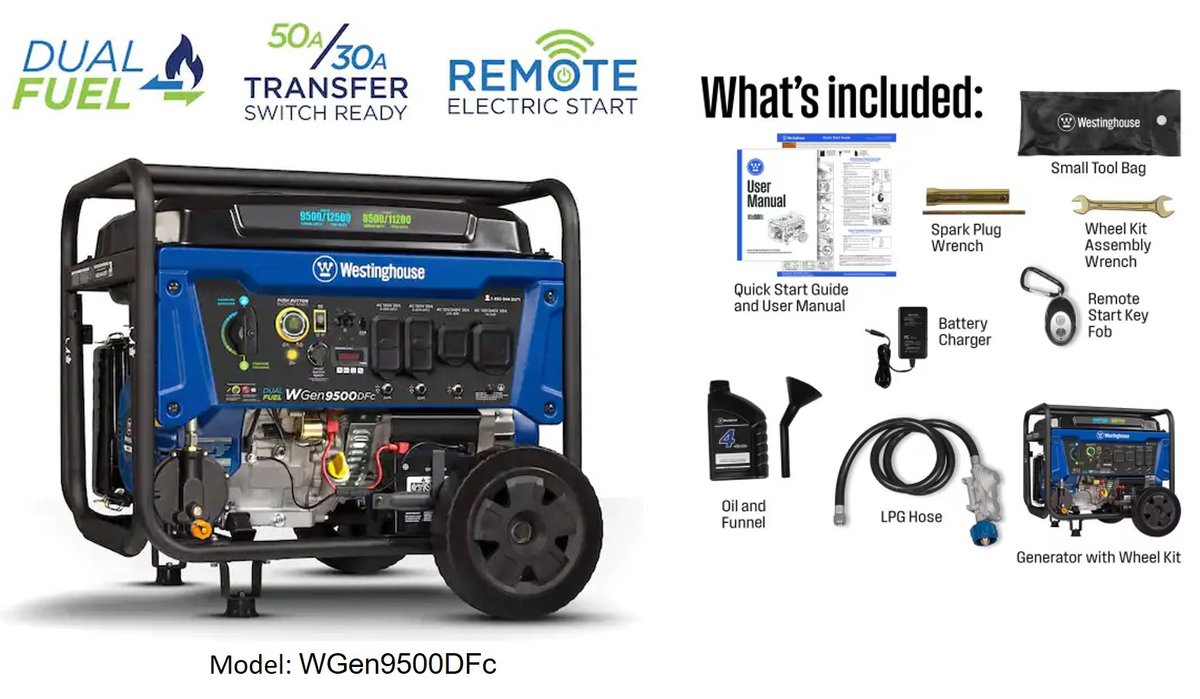
Stepping Up: The WGen9500DF (or similar)
For those needing more juice – perhaps to run a central air conditioner or more extensive home backup – the 9500DF class is a significant upgrade.
- Typical Power Output: Roughly 9500 running watts on gasoline, around 8500 running watts on propane. Starting watts could push 12,500.
- Engine: Often a larger 457cc or 4-stroke engine.
- Run Time: Similar to the 7500DF, but often with a slightly larger fuel tank (e.g., 6.9-gallon) for extended gasoline run times at lower loads.
- Outlets: In addition to the outlets found on the 7500DF, you might find a 50A 120V/240V outlet (14-50R) for connecting to larger transfer switches or high-demand appliances.
- Key Features: All the features of the 7500DF, plus often heavier-duty components, potentially a larger battery for electric start, and sometimes Automatic Transfer Switch (ATS) readiness for seamless home backup integration (though check individual model for specific ATS compatibility).
- Ideal For: Whole-home emergency power (excluding very large central AC units), demanding job sites, or large RVs with multiple high-draw appliances.
Heavy-Duty Power: The WGen12000DF (or similar)
This category is for serious power needs, whether it's powering an entire home during an outage, or running heavy equipment on a construction site.
- Typical Power Output: Massive power, often 12,000 running watts on gasoline, and around 10,800 on propane. Starting watts can reach 15,000 or more.
- Engine: A powerful V-twin engine, typically 713cc or higher, designed for sustained heavy loads.
- Run Time: With a substantial fuel tank (e.g., 10.5 gallons), these models can offer impressive run times, even under significant load.
- Outlets: Comprehensive array of outlets, including multiple 120V outlets, a 30A 120V/240V twist-lock (L14-30R), and a 50A 120V/240V outlet (14-50R) for connecting to a home's electrical panel via a transfer switch.
- Key Features: All the premium features: electric start, remote start, robust frame, heavy-duty wheels, advanced digital displays, and often ATS readiness.
- Ideal For: Whole-home backup, powering multiple large appliances including central air conditioning, or heavy-duty commercial/industrial applications.
Choosing Your Perfect Dual Fuel Generator: A Decision Framework
Selecting the right generator isn't just about raw power. It's about matching capabilities to your specific needs, considering everything from your usage scenario to your local environment.
1. Power Needs: Calculate Your Wattage Carefully
Before looking at any Westinghouse Dual Fuel Generator Models & Specs, make a list of everything you might want to power.
- Essential Home Items: Refrigerator, freezer, lights, furnace fan, well pump, sump pump, TV, phone chargers.
- Comfort Items: Microwave, coffee maker, window AC unit, central AC.
- Tools: Circular saw, air compressor, welder.
For each item, note its running watts and starting watts (usually found on a label or in the owner's manual).
Your Calculation Steps:
- Add up the running watts of all items you want to use simultaneously. This gives you your minimum running watt requirement.
- Identify the single item with the highest starting watts.
- Add that highest starting watt value to the total running watts of all other items you'll be running simultaneously. This gives you your total starting watt requirement.
Example:
- Refrigerator: 800 running / 2200 starting
- Lights (total): 300 running / 0 starting
- Sump Pump: 1000 running / 2000 starting
- TV: 100 running / 0 starting
- Total Running Watts: 800 + 300 + 1000 + 100 = 2200 watts
- Highest Starting Watt Item: Refrigerator (2200 watts) or Sump Pump (2000 watts). Let's say you'd start the sump pump first.
- Required Starting Watts: (800+300+100) + 2000 (Sump Pump) = 3200 watts.
- Your generator needs at least 2200 running watts and 3200 starting watts (on its lowest fuel output, typically propane). A Westinghouse WGen7500DF would easily handle this.
2. Fuel Flexibility: Gasoline vs. Propane Considerations
The dual fuel capability is a game-changer, but understand the trade-offs:
- Gasoline: Higher power output (generally 10-15% more), widely available. However, it degrades over time (requiring stabilizers), can be messy, and emits more pollutants.
- Propane: Lower power output, burns cleaner, has an indefinite shelf life, readily available in tanks, and safer to store. It's often more expensive per BTU than gasoline but can be more convenient.
Consider how you'll store each fuel and which is more accessible in your typical use scenarios.
3. Portability vs. Power: Where Will You Use It?
- Home Backup: A heavier, higher-wattage unit (like a WGen9500DF or WGen12000DF) can be great if it stays put. Look for robust wheel kits and handles.
- RV/Camping/Tailgating: You might prioritize a lighter, potentially quieter model, even if it has slightly less power. Noise levels are particularly important in campgrounds.
- Job Site: Power and durability are key. Heavy-duty frames and outlets for specific tools will be important.
4. Noise Levels: Keep the Peace
A generator running at 70 dB is roughly as loud as a vacuum cleaner. At 60 dB, it's more like a normal conversation. If you have close neighbors or use the generator in recreational settings, prioritize lower dB ratings. Conventional generators are typically louder than inverter generators, but the WGen series tries to balance power with reasonable noise.
5. Starting Options: Convenience is King
- Recoil Start Only: Most affordable, but can be a workout.
- Electric Start: Push-button convenience, standard on many Westinghouse dual fuel models. Battery maintenance is a consideration.
- Remote Start: The ultimate convenience, allowing you to start the generator from inside your home or RV.
6. Safety Features: Non-Negotiables
- CO Sensor: Crucial for safety. Westinghouse's CO Sensor automatically shuts off the generator if dangerous levels of carbon monoxide are detected.
- Low Oil Shut-off: Protects the engine from damage by automatically turning it off if the oil level drops too low.
- Overload Protection: Prevents damage to the generator and connected appliances if too much power is drawn.
- GFCI Outlets: Ground Fault Circuit Interrupter outlets protect against electric shock, especially useful in wet conditions.
7. Outlets & Connectivity: Plan Ahead
Ensure the generator has the right outlets for your needs. If you plan to connect it to your home's electrical panel via a transfer switch, you'll need a specific 30A or 50A 120V/240V twist-lock receptacle (L14-30R or 14-50R). For RVs, a TT-30R is essential.
8. Budget: Balancing Cost and Features
Determine your budget, but remember that a generator is an investment in peace of mind and functionality. Sometimes, spending a little more for crucial features like electric start, a CO sensor, or higher wattage can save you headaches (and potential damage) down the line.
Operating Your Westinghouse Dual Fuel Safely & Effectively
Owning a generator is one thing; operating and maintaining it correctly is another. Proper practices ensure longevity, efficiency, and most importantly, safety.
First Start and Setup
- Read the Manual: This is non-negotiable. Every Westinghouse dual fuel generator has specific instructions.
- Add Oil: Generators are typically shipped without oil. Use the recommended type and amount (often 10W-30). Do not overfill.
- Add Fuel: Choose either gasoline (fresh, stabilized) or connect a propane tank. Ensure all fuel connections are secure and leak-free.
- Position Safely: Always operate generators outdoors in a well-ventilventilated area, at least 20 feet away from any windows, doors, or vents of your home or other buildings. Point the exhaust away from structures.
- Grounding: While many modern portable generators are designed with a floating neutral (which doesn't require external grounding for basic use), check your manual and local electrical codes. If you're connecting to a home transfer switch, proper grounding is critical.
Managing Dual Fuel: Switching & Storage
One of the great advantages is the ability to switch fuels.
- Switching Mid-Operation: Most Westinghouse dual fuel models allow you to switch from gasoline to propane (or vice-versa) while the generator is running. Simply turn off the fuel supply for one, wait for the engine to sputter, then open the supply for the other. Refer to your specific model's manual for the exact procedure.
- Fuel Storage:
- Gasoline: Always use fresh gasoline, preferably treated with a fuel stabilizer, especially if storing for more than a month. Store in approved containers in a cool, dry, well-ventilated area away from living spaces.
- Propane: Propane has an indefinite shelf life. Store propane tanks outdoors, in a shaded area, and upright. Ensure the tank valve is fully closed when not in use.
Maintenance Essentials: Keep It Running Smoothly
Regular maintenance prevents issues and extends the life of your generator.
- Oil Changes: Follow the manual's schedule, typically after the first 20-30 hours, then every 50-100 hours or annually.
- Air Filter: Clean or replace the air filter regularly, especially in dusty conditions.
- Spark Plug: Inspect and clean or replace the spark plug annually or as recommended.
- Fuel System: If running on gasoline, it's good practice to run the generator until the fuel tank is empty before long-term storage, or use a fuel stabilizer and "exercise" the generator periodically.
- Battery Check: For electric start models, keep the battery charged and check terminals for corrosion.
Safety First, Always
- Carbon Monoxide (CO): This colorless, odorless gas is deadly. Always use generators outdoors. Your Westinghouse CO Sensor is a vital backup, but never rely on it as the primary safety measure. Install CO alarms in your home.
- Electrical Safety: Never backfeed power into your home's electrical system without a professionally installed transfer switch. Use heavy-duty, outdoor-rated extension cords.
- Fire Safety: Keep a fire extinguisher nearby. Never refuel a hot or running generator.
Common Questions About Westinghouse Dual Fuel Generators
Let's clear up some common queries you might have when considering a dual fuel generator.
Can I convert my existing gasoline generator to dual fuel?
Generally, no. Westinghouse dual fuel generators are specifically designed and manufactured to safely operate with both fuel types. Attempting to modify a single-fuel generator yourself can be dangerous, void the warranty, and lead to poor performance or engine damage. It's always best to purchase a dedicated dual fuel model.
What's the difference in power output between gas and propane?
Propane typically provides about 10-15% less wattage compared to gasoline for the same generator model. Always check the specific running and starting watt ratings for both fuels in the generator's specifications.
Is propane cheaper to run than gasoline?
This varies significantly based on local fuel prices. While propane may be more expensive per gallon or per BTU, its longer shelf life, cleaner burn (reducing maintenance), and potential for bulk purchase can sometimes make it a more cost-effective choice in the long run, especially for infrequent emergency use.
How long can I store propane vs. gasoline?
Propane has an indefinite shelf life as long as the tank is properly maintained and sealed. Gasoline, however, begins to degrade after about 3-6 months, even with fuel stabilizer, and can cause carburetor issues. If storing gasoline, always use a stabilizer and rotate your fuel supply regularly.
Are Westinghouse dual fuel generators ATS compatible?
Many higher-wattage Westinghouse dual fuel generators, especially within the WGen series like the WGen9500DF and WGen12000DF, are "ATS Ready." This means they can be connected to an automatic transfer switch, allowing the generator to automatically start and transfer power to your home's circuits when grid power fails. Always confirm this feature for the specific model you're considering and consult with a qualified electrician for installation.
What does the "DF" in model numbers like WGen7500DF stand for?
"DF" simply stands for "Dual Fuel," indicating that the generator can operate on both gasoline and propane.
Making the Smart Choice for Your Power Needs
Choosing a Westinghouse dual fuel generator means investing in reliability, versatility, and peace of mind. By carefully evaluating your power requirements, understanding the nuanced differences between models and their specs, and committing to safe operation and consistent maintenance, you'll ensure that your generator is ready to deliver power whenever and wherever you need it.
Whether it's for emergency home backup, powering your RV adventures, or keeping a job site humming, the right Westinghouse dual fuel generator provides the flexibility to adapt to any situation. Take the time to make an informed decision, and you'll be well-prepared for whatever comes next.